

Why This Still Hurts
Planning and execution aren’t separate functions; they’re a continuum. But in most organizations, they operate like estranged siblings. We build pragmatic plans that get lost in translation and then we execute frantically, often on the wrong things. The gap isn’t just a focus problem. It’s a failure in leadership.
This expanded guide goes beyond theories and PPTs. It’s built for VP-level leaders who are accountable for both setting the plan and delivering the outcomes. It focuses on five critical gaps and how to fix them.
Who Owns the Bridge?
(Role Clarity & Accountability)
Ownership is the foundation. If everyone is responsible for everything, no one is actually responsible for anything. It is truly painful and nothing gets done. You need individuals accountable to bring focus and deliver results.
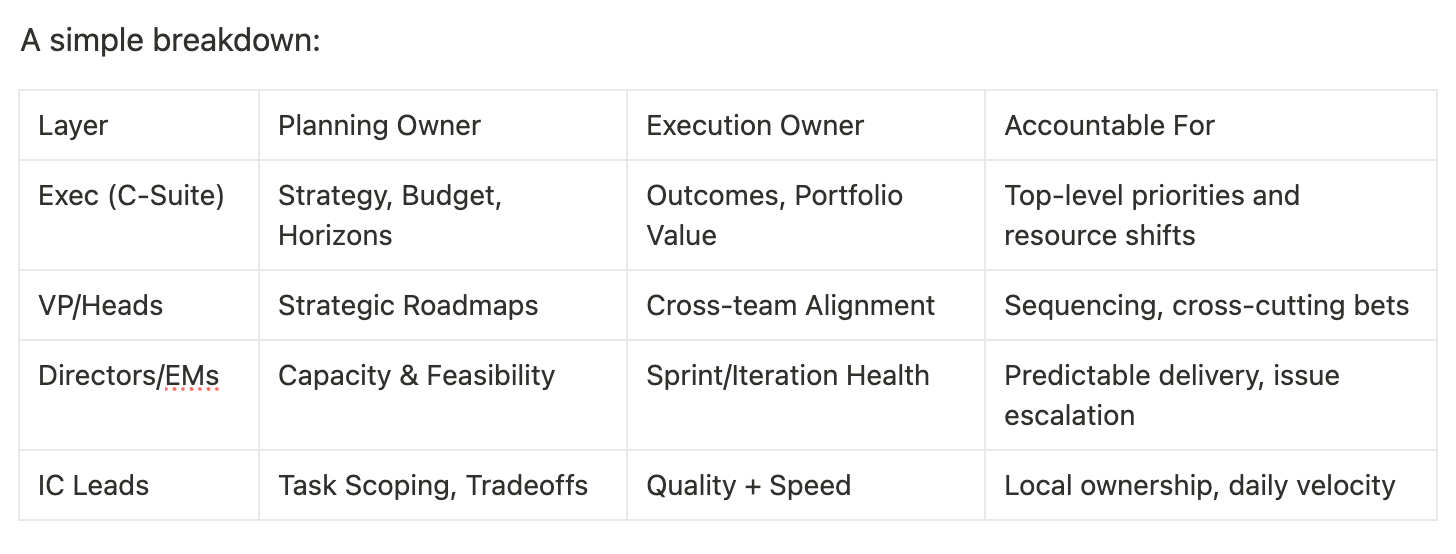
If accountability isn’t explicit in your org, write it down. Reiterate it monthly. Otherwise, chaos.
What Does Great Execution Look Like?
(Signals & Systems)
Planning isn’t just about setting direction. I genuinely believe most people want to win. They want to see value and positive returns. BUT, in order to do so, your organization requires systems that enable people to get shit done. Planning MUST include designing those systems.
Key Signals of Great Execution:
Mission, vision and priorities are known at every level (company, team, individual)
Work-in-progress (WIP) is constrained and visible
Unplanned work is surfaced and triaged
Delivery is boringly predictable
Retrospectives lead to real behaviour change
Minimum Operating System (MOS):
Quarterly planning tied to strategy
Monthly exec review of outcomes vs. promises
Biweekly planning is tied to capacity.
Weekly checkpoint on risk, blockers, and scope creep
Sprint review that checks output against the original intent (not just demo theater)
Discipline beats any level of motivation or brilliance here.
Middle Management: The Execution Enablers
Most failures happen in the messy middle.
Your EMs and Directors need to:
Translate strategy into actionable priorities
Drive accountability without micromanagement
Protect teams from noise (and execs trying to inject “one more thing…”)

How to equip them:
Planning Playbook: Train them to run effective quarterly + sprint planning sessions
Capacity Toolkit: Teach realistic estimation, 80% allocation rules, and unplanned buffer modeling
Escalation Paths: Create clarity on what issues should bubble up vs. be resolved locally
Delivery KPIs: Track health with things like outcomes realized (did we do the things we said we would do in the time committed), blocker age, time to value (customer + internal) and team pulse (surveys, retro patterns and outcome ratio of delivered:team satisfaction)
The best VPs turn directors into operational powerhouses for their portfolios.

What Happens When We Miss?
(Accountability Loops)
Many individuals, including leaders, avoid accountability because it feels like a form of punishment. It requires people to put themselves out there and be open to both winning and failure. The fear of failure deters accountability. But accountability done right is about growth and learning loops. Think first principles!
When outcomes slip:
Run a Fast Postmortem (within 5 days): What happened? Why? What will we change?
Assess at the Right Layer: Was it a team-level issue? Or a cross-team misalignment? Don’t default to blaming the doers.
Reconfirm Priority: Sometimes the delay signals that the work isn’t as important anymore. Remove or shrink the scope.
Reset the Cadence: Use delivery slippage to revisit how often you check in. Monthly might be too slow.

Here are some anti-patterns to avoid:
Delaying the reckoning until the next quarter
Death-by-powerpoint retros with no owner on actions
Teams padding estimates just to avoid scrutiny
Teams that are quiet in retros but vocal in private conversations
Great orgs make missing a milestone a moment for growth, not embarrassment or stopping altogether (slowing down is entirely different).
How to Keep the Whole Org Moving
(Leadership Habits That Matter)
There is something to be said for the energy that is brought to work. Positive, focused, determined and with some level of urgency to WIN. You need habits that help teams move forward even when things get messy…and they will get messy:
Cadence + Clarity + Calm
Communication is the invisible force behind all of our work. Without clear, timely, and context-rich communication, even the best plans and outcomes will collapse.
Cadence: Establish planning/review/comm check-ins and never skip them
Clarity: Reaffirm what "done" means for every major body of work
Calm: When it all goes sideways (and it will), be the one who breathes first
Leadership Checkpoints
Every 2 weeks, ask:
Are we doing what we said we would do? (HUGE trust builder)
Are we working on the right things!?
Are we getting it done on time? If not, where is the blockage?
What needs escalation vs. local resolution? (Think empowered teams!)
Create the conditions for execution:
Set clear OKRs tied to reality
Align incentives (no bonuses for vapourware!)
Protect team capacity with ruthless prioritization
Celebrate outcome-based wins, not just heroic efforts
Final Thoughts: This Is About Leadership
Planning and execution are not just team responsibilities. They reflect the maturity of leadership within the organization.

If you’re a VP:
Create the bridge.
Own the gaps and go for them.
Show your teams what GREAT looks like.
Planning without delivery is a hallucination. Delivery without planning is a waste of everyone’s time and money. Your job is to stitch them together.
Let’s close the monster gap.
Thanks for reading!
-Adam